How Nigerian Creatives Can Profit From Africa’s Fast-Growing Gaming Industry
Africa’s Gaming Industry Is Worth Over $1 Billion. So Why Aren’t More Nigerian Creatives Making Money From It?
When most people hear the word gaming, they immediately think of people sitting in front of a screen playing FIFA, PUBG, Call of Duty, or Candy Crush.
But that’s only one side of the story.
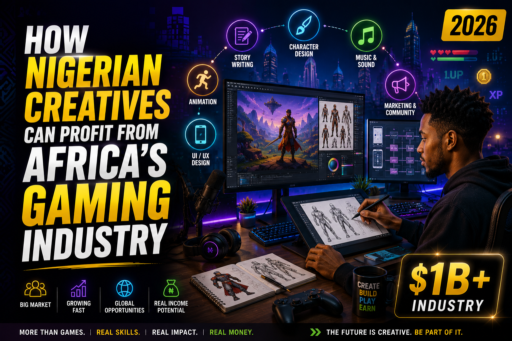
Behind every successful game is an entire team of creative professionals. Someone writes the story. Another person designs the characters. Someone else creates the artwork, animation, music, sound effects, user interface, and marketing campaigns that make people want to play.
In other words, the gaming industry isn’t just for programmers.
It’s a creative industry, and one of the fastest-growing in Africa.
However, one question creatives ask is, is there really money in Africa Gaming Industry? And how can creatives profit from this booming Africa’s Gaming Industry?
According to industry reports, Africa’s gaming market generated more than $1 billion in revenue in 2024, driven largely by the rapid growth of smartphone users and affordable internet access. Mobile gaming now accounts for nearly 90% of the market, and experts predict the industry could grow to $10 billion by 2033.
That kind of growth means one thing:
More opportunities for creative professionals.
Here’s the surprising part.
Many Nigerian writers, designers, illustrators, musicians, and digital creators don’t even consider the gaming industry when looking for work.
Why?
Because they’ve been told one thing for years:
“You have to know how to code.”
That’s simply not true.
While developers build the technical side of a game, many other professionals help bring it to life.
Game studios need storytellers to write dialogue and build fictional worlds. They need illustrators and concept artists to design characters and environments. They hire animators to create movement, musicians to compose soundtracks, voice actors to bring characters to life, UI and UX designers to improve the player’s experience, and marketers to promote the final product.
If you already create with words, images, audio, or design, you may already have skills the gaming industry needs.
Why Nigeria Is Falling Behind
Nigeria has one of Africa’s largest youth populations and one of the continent’s fastest-growing creative industries.
Yet many talented creatives still compete for the same freelance writing jobs, graphic design gigs, or social media contracts without realizing another industry is actively looking for their skills.
The biggest challenge isn’t talent.
It’s awareness.
Many schools don’t teach game design. Few creatives know how the industry works, and even fewer understand how their existing skills fit into it.
As a result, many opportunities go unnoticed.
Gaming has become a serious business.
Studios create educational games, mobile games, sports games, adventure games, simulation games, and even games that help companies train employees.
Every new game is a product that requires planning, storytelling, branding, marketing, customer support, and community management.
That’s why the gaming industry creates jobs for far more people than just software developers.
How Nigerian Creatives Can Get Started With Making Profit From Africa’s Gaming Industry
Breaking into gaming doesn’t always require a computer science degree. It starts by identifying the skills you already have.
If you’re a writer, learn how game stories and dialogue are written.
As an illustrator or graphic designer, you should build character designs or environment art for your portfolio.
A musician or sound designer? Experiment with creating background music and sound effects for games.
You can also explore beginner-friendly tools like Unity, Unreal Engine, Blender, or Figma to understand how games are built and where your skills fit into the process.
Most importantly, connect with game development communities, join online courses, participate in game plays, and follow African gaming studios to understand the industry’s needs.
Final Thoughts
Africa’s gaming industry is no longer a future opportunity, it’s already creating jobs, businesses, and careers.
As the market continues to grow, the demand for creative talent will grow with it.
The question isn’t whether opportunities exist.
They do.
The real question is whether Nigerian creatives will continue overlooking one of Africa’s fastest-growing industries or position themselves early enough to benefit from it.
Sometimes, the next big opportunity isn’t learning an entirely new skill.
It’s discovering a new industry that already needs the skills you have.