Nigeria Fashion Week 2026 Calls for Fashion Industry Investment
Nigeria Fashion Week Puts Funding and Investment on the Agenda
Nigeria Fashion Week 2026 brought a question facing many fashion businesses into focus: how can the country’s creative talent attract the capital, infrastructure and market access needed to grow?
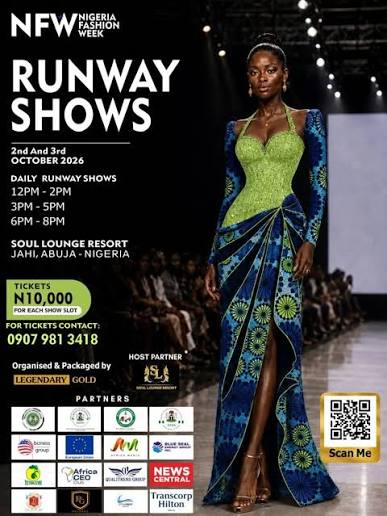
Held in Abuja from October 1–4, the event brought together designers, creative entrepreneurs, government representatives, financial institutions and other stakeholders under the theme “Where Capital Meets Creativity.”
The conversations went beyond runway presentations. Participants called for increased investment, stronger partnerships and policies that could help unlock the economic potential of Nigeria’s fashion industry.
For designers and fashion entrepreneurs, the message was significant. Creative talent can attract attention, but building a lasting business also requires production capacity, working capital, reliable supply chains, market access and the ability to meet demand.
Why funding became a central issue
Fashion businesses often face a gap between creating a product and scaling production.
A designer may have a strong collection and a growing customer base but lack the capital to buy materials in bulk, pay skilled workers, maintain production schedules or fulfil larger orders. Other businesses may have the production capability but struggle to reach new markets or build the operational systems needed to supply retailers consistently.
At Nigeria Fashion Week, the call for investment highlighted the need to treat fashion not only as a creative pursuit but also as an industry with business and employment potential.
That means looking beyond the runway to the wider value chain: textile production, garment manufacturing, accessories, logistics, retail, marketing and exports.
Government calls for a stronger creative-economy framework
At the event, the Federal Government indicated that it was working on a framework intended to strengthen Nigeria’s creative economy and address gaps in areas including data, funding, infrastructure and market support.
The Minister of Art, Culture, Tourism and the Creative Economy, Hannatu Musawa, discussed the need for better data to understand the sector and support more deliberate policy decisions.
The issue of data matters because it can be difficult to attract investment into an industry when reliable information about its size, businesses, workforce, production capacity and economic contribution is limited.
Better information can help policymakers identify bottlenecks and give investors a clearer picture of where opportunities exist. A framework, however, is only a starting point; its impact will depend on how policies are implemented and whether businesses can access practical support.
What fashion entrepreneurs need from investment
Investment can mean different things depending on the size and stage of a fashion business. For some designers, it may mean a loan or working-capital facility. Others may need an equity partner, manufacturing equipment, retail distribution or a commercial relationship with a buyer.
Several areas deserve attention.
1. Access to working capital
Fashion production requires spending before revenue arrives. Designers may need to pay for fabrics, sampling, labour, packaging and transport before customers complete their purchases.
Appropriate financing can help businesses manage that gap. But funding terms matter: repayment schedules and borrowing costs must match the business’s cash flow, particularly when sales are seasonal.
2. Better production infrastructure
Reliable equipment, workspace, electricity, skilled labour and access to materials can affect both the quality and volume of production.
Investment in shared production facilities, training and manufacturing capacity could help smaller businesses fulfil orders more consistently and compete for larger contracts.
3. Access to customers and markets
Designers need ways to reach customers beyond personal networks and occasional fashion events. Retail partnerships, e-commerce, wholesale relationships and export support can help turn attention into repeat sales.
Fashion businesses also need to understand the requirements of their target markets, including sizing, quality control, delivery timelines, pricing and compliance.
4. Skills and business support
Creative ability is central to fashion, but business growth also involves pricing, bookkeeping, inventory management, marketing, production planning and customer service.
Training and advisory support can help designers build the systems required to manage growth without compromising the quality or identity of their work.
Why partnerships matter
The theme “Where Capital Meets Creativity” also points to the importance of relationships between fashion businesses and institutions that may not traditionally view themselves as part of the creative sector.
Banks and other financial institutions can explore financing products suited to fashion businesses. Manufacturers and suppliers can help improve production reliability. Retailers can create routes to market, while government agencies and industry organizations can help with training, standards and export readiness.
The challenge is to make those relationships practical. A networking conversation is valuable only if it leads to a clearer route toward funding, an order, a partnership, training or another concrete business outcome.
What does this mean for emerging designers?
For emerging designers, the investment conversation should not be interpreted as a reason to seek funding before the business is ready.
A designer preparing to approach an investor or lender should understand the business’s costs, margins, production capacity and customers. Even a small operation can begin documenting which products sell, how long they take to produce, how much cash is required for each production cycle and which marketing channels generate sales.
That information can help the designer decide whether the next step is financing, better production planning, a retail partnership or a more focused product range.
It also gives potential partners a clearer basis for assessing the opportunity.
Beyond the runway
Nigeria Fashion Week 2026 put an important issue on the table: the fashion industry needs an environment where creative talent can develop into viable businesses.
The next phase will depend on whether calls for funding, infrastructure, better data and market access lead to concrete programs and partnerships. Designers need more than visibility; they need the conditions that allow them to produce, sell and grow.
For Nigeria’s fashion sector, the real measure of progress will be whether more businesses can turn their creativity into sustainable operations, reliable jobs and products that reach customers at home and abroad.