Dapper Music Leads Nigerian-Owned Labels in 2026 Market Share
Dapper Leads Nigerian-Owned Labels in Mid-Year Market-Share Ranking
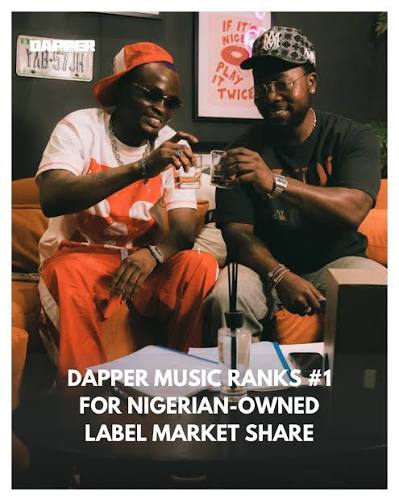
Dapper Music & Entertainment has retained its position as Nigeria’s leading locally owned music label in the first half of 2026, according to TurnTable Charts’ Mid-Year Market Share Report.
The Lagos-based company recorded a 3.82% share of Nigeria’s streaming market between January and June, ahead of YBNL Nation, GIRAN Republic, Starboy Entertainment and Dangbana Republik among Nigerian-owned companies.
The ranking offers a snapshot of the competition between local music businesses at a time when labels are balancing artist development, digital distribution, catalogue performance and the search for sustainable revenue.
But there is an important detail behind Dapper’s leading position: its share was down from 6.76% in the first half of 2025. The company remained the leading Nigerian-owned label in the latest report, even as its share of the overall market contracted.
How did Nigerian-owned labels rank?
According to TurnTable Charts’ report, the top five Nigerian-owned music companies by first-half 2026 market share were:
Dapper Music & Entertainment — 3.82%
YBNL Nation — 2.40%
GIRAN Republic — 1.99%
Starboy Entertainment — 1.50%
Dangbana Republik — 1.42%
Other companies in the Nigerian-owned top 10 included NSNV Inc., MAD Solutions, KeyQaad, To Your Ears Entertainment and Mavin Records.
Together, the 10 leading Nigerian-owned companies accounted for 17.29% of the market measured in the report. This figure should be understood within TurnTable Charts’ market-share methodology, rather than as a measure of all music revenue or the full economic value of Nigeria’s music industry.
Dapper’s lead comes with a caveat
Dapper’s 3.82% share placed it ahead of other Nigerian-owned companies, but the year-on-year comparison shows a more complicated picture.
TurnTable Charts reported that Dapper’s share fell from 6.76% in the first half of 2025 to 3.82% in the first half of 2026, a decline of 43.4%.
That does not erase the company’s position at the top of the domestic ranking. It does, however, show why market leadership and market growth are not the same thing.
A label can rank first among local competitors while still losing share to other companies. Market share is also influenced by the performance of rival catalogues, the timing of major releases and how streaming activity is distributed across the market.
International companies still dominate the overall ranking
Dapper ranked fifth overall, behind EMPIRE, Virgin Music, Warner Music Group and Universal Music Group.
EMPIRE led the overall market with an 11.30% share, according to TurnTable Charts. Its position illustrates the scale of competition facing Nigerian-owned businesses: a locally owned label may lead its domestic peer group while competing with international companies that have broader distribution networks, extensive catalogues and partnerships across multiple markets.
For local labels, the challenge is not only to sign successful artists. It is also to build the business systems that help music reach listeners, manage rights, maintain catalogues and generate income over time.
What the ranking means for Nigerian music businesses
The report is useful because it provides a measurable view of how the market is divided. It also invites a broader conversation about what makes a label commercially resilient.
Artist development remains important
A label’s performance is closely tied to the music it releases and the artists it supports. Discovering talent is only one part of the work; helping artists release consistently, connect with audiences and develop long-term careers matters too.
Distribution and rights management are part of the business
Digital distribution, publishing administration and rights management can affect how a company earns from the music it helps bring to market. Labels that develop capabilities beyond recording and artist promotion may have more ways to serve artists and diversify their operations.
A ranking is a snapshot, not a complete business assessment
Market share does not necessarily reveal a company’s profitability, costs, debt, contract structures or how much income reaches artists. Nor does a higher share automatically mean that every artist signed to that company is performing better than artists at competing labels.
For artists choosing a label or distribution partner, the ranking may be one useful reference point—but it should not replace careful consideration of contracts, services, rights, reporting and the support actually offered.
What happens next?
Dapper’s position gives it a clear lead among Nigerian-owned companies in the first-half report, but the next market-share update will show whether the company can sustain that position and how competitors respond.
For the wider Nigerian music business, the bigger question is how local companies can turn audience demand into lasting businesses—not only through hit releases, but also through rights, distribution, publishing, live entertainment and other parts of the music value chain.