Africa’s Creative Economy Is Finally Getting More Serious About Financing
For a long time, Africa’s creative economy has had a financing problem that everyone knew about but few institutions seemed prepared to solve.
Ofcourse the talent was obvious, the audiences were growing and African music was travelling globally. Nollywood was producing thousands of films. African fashion was entering international markets. Gaming, animation, publishing and digital content were developing new audiences. But when it came to financing the businesses behind all of this, the traditional financial system often struggled to know what to do with them.
However, that may finally be changing as this 2026 has come with it different funding opportunities for African creatives.. Across Africa, governments, banks, development-finance institutions and private companies are beginning to build funds, debt facilities, accelerators and investment vehicles specifically around creative businesses. The money is not yet enough to solve the continent’s financing gap but the architecture is beginning to look different.
The problem has never really been talent
Nigeria’s iDICE program recently put the problem rather bluntly. Speaking at the QEDNG Creative Powerhouse Summit in Lagos, iDICE National Coordinator Ife Adebayo said Nigeria had abundant creative talent but lacked the capital, skills, infrastructure and systems required to turn that talent into sustainable businesses.
That is the central problem. A filmmaker may have a commercially viable idea but no collateral for a bank loan. Same way a fashion brand may have customers but lack working capital to increase production and a music company may own valuable intellectual property but have no conventional asset that a bank is comfortable lending against. A game studio may have a promising product but need years of development before meaningful revenue arrives.
Traditional finance isn’t always designed for these businesses. So creative entrepreneurs have often had to rely on personal savings, friends and family, grants, informal investors or whatever commercial opportunities they can find.
That limits how quickly the industry can scale.
Now the money is starting to look different
Consider what is happening across the continent. In South Africa, the government announced plans for a R150 million Creative Sector Fund for the 2026/27 financial year.
The fund is intended to support businesses across music, film, fashion, design, animation, gaming, digital content and visual arts. The government has explicitly framed the initiative around turning creativity into enterprise and intellectual property into an economic asset.
In Nigeria, the iDICE financing structure includes a $170.6 million minimum target capitalization for its Fund of Funds, with an $85.3 million government anchor commitment and a mandate to raise matching private capital.
The program also includes debt financing, with the Bank of Industry’s iDICE Debt Fund and an Islamic Development Bank Murabaha Debt Fund together earmarking about $110 million for technology and creative-sector startups, according to iDICE. And that isn’t the only money entering the space.
The programme is targeting early-stage businesses working across music, film and media, design and creative technology. Selected startups are expected to receive between $20,000 and $50,000, alongside mentorship, investor-readiness support and strategic partnerships. The significance here isn’t simply the size of the cheque.
It is who is writing it. Chocolate City is itself a creative-industry company. That gives the fund an interesting advantage: it is being built by people who understand some of the commercial realities of the sector rather than investors approaching creativity as an unfamiliar category. It also signals a subtle shift.
The question is moving from:
“How do we support artists?”
to:
“How do we finance the businesses building Africa’s creative economy?”
Film is attracting institutional-scale capital
Perhaps the clearest indication that things are changing is happening in film.
Afreximbank and its development impact investment arm, the Fund for Export Development in Africa (FEDA), appointed One Street Studios as co-general partner of the Pan African Film Fund, which aims to mobilize up to US$1 billion for Africa’s film, television and immersive-media industries.
A billion dollars is a very different conversation from a grant program. It suggests an attempt to treat African audiovisual production as an industry capable of attracting large-scale capital. The objective is not merely to fund individual films. It is to build capacity around production, infrastructure and the wider audiovisual ecosystem.
That matters because film creates value far beyond the finished movie. There are studios, equipment, post-production, distribution, streaming, intellectual property, merchandising, international licensing and employment. The more efficiently capital can move through that ecosystem, the more economic value the industry can potentially capture.
Also, African Export-Import Bank (Afreximbank) through its Creative Africa Nexus (CANEX) program, in partnership with Gebeya is also has an ongoing $50,000 create-thon called the CANEX Create-thon 2026.
And investors are beginning to talk about “patient capital”
There is also a growing recognition that creative businesses don’t always behave like conventional startups.
A technology company might be expected to scale rapidly.
A fashion brand may require years to build a customer base.
A film project may have a long production and distribution cycle.
A publishing company may build value through a catalogue over time.
A creative IP company may spend years developing a property before it generates significant commercial returns.
That is why the emergence of dedicated creative investment vehicles is important.
For example, IFFAC describes itself as a US$150 million patient-capital platform focused specifically on Africa’s cultural and creative industries, targeting 16+ creative subsectors and combining investment with technical support and market access.
Whether every announced fund ultimately deploys capital at the scale advertised is another question. But the investment thesis is becoming increasingly explicit:
Africa’s creative economy is not charity. It is an asset class waiting for the right financial structures.
The IP conversation could be the game changer
One of the most interesting developments in Nigeria is the government’s work around intellectual-property financing.
The iDICE program says it is working with government stakeholders on an IP securitization framework that could allow creative intellectual property to carry greater financial value. This could be significant.
Imagine a music company owning a catalogue that generates predictable royalty income, or a film company owning valuable distribution rights. It could also be a media company owning a library of successful formats or a game studio owning an established franchise. These are assets.
The challenge is figuring out how to value them, verify the underlying revenue and structure financing around them. If African financial institutions become comfortable doing that, the creative economy could unlock a completely different source of capital.
But money alone won’t fix the sector
This is where we need to be careful. A billion-dollar fund announcement doesn’t automatically mean a filmmaker in Lagos, a fashion designer in Kampala or a game developer in Johannesburg can suddenly walk into a bank and get financing. The financing pipeline still has major gaps.
Many creative businesses remain informal.
Financial records can be weak.
Intellectual-property ownership may be unclear.
Revenue can be unpredictable.
Founders may not have investment-ready business plans.
And investors may still struggle to understand the economics of individual creative subsectors.
That is why the infrastructure around the money matters just as much as the money itself.
Incubators, Accelerators, Financial literacy, IP registration, Business management, Accounting, Legal support, Market access, Distribution and Investment readiness. These systems help turn a creative entrepreneur into a business that capital can actually understand.
That is why incubation programmes matter too
The recently announced Création Africa 2 cohort in Southern Africa is a good example.
Fifteen businesses from South Africa, Lesotho and Malawi were selected from more than 340 applicants for a seven-month incubation program designed around stronger business models, value propositions, investor networks and funding readiness.
That is effectively the missing middle between “I have a creative idea” and “I am ready for investment.” And that middle is where much of Africa’s creative economy needs to improve.
The real shift is in the language
Perhaps the biggest change is not even the amount of money being announced. It is the language being used.
Governments are increasingly talking about creative enterprises. Banks are talking about finance. Development institutions are talking about investment. Private companies are launching creative funds. Investors are discussing intellectual property and patient capital.
That is a very different conversation from simply celebrating African creativity and it matters because the way an industry is described often influences the way it gets financed.
If music is entertainment, it gets sponsorship.
If music is an industry, it can attract investment.
If fashion is culture, it gets grants.
If fashion is an export business, it can attract working capital.
If film is art, it needs patrons.
If film is an IP business, it can potentially attract structured finance.
Other Funding Opportunities for African Creatives in 2026
NASENI and Afrilabs launch $25k Xcelre8 accelerator for Nigerian Innovators – Read More
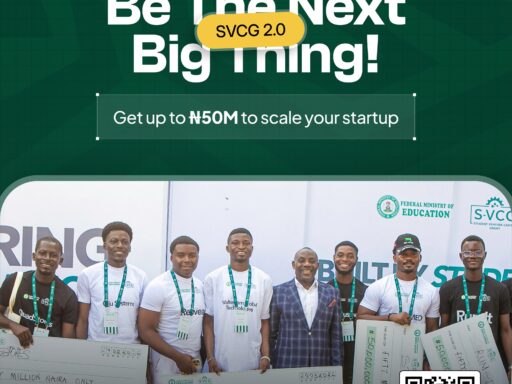
S-VCG Cohort 2 2026: 50 Nigerian Student Startups to Get ₦50 Million Grant Each – Read More
Aptech & Middlesex University Award N701 Million in Tech Scholarships – Read More
HEVA Fund and NCBA KES 20 million Start-Up Fund for Kenyan Creatives, Entrepreneurs – Read More
Africa still has a long way to go
It would be premature to declare that Africa has solved its creative financing problem because it hasn’t. There is still a huge gap between the capital available and the capital required and announcing funds is easier than deploying them effectively. But something important is happening.
The institutions around Africa’s creative economy are increasingly recognizing that talent without capital creates output, not necessarily wealth. The next stage is about building businesses capable of capturing the value that African creativity already generates. That means financing the studio, not just the artist.
The production company, not just the film.
The fashion brand, not just the designer.
The game studio, not just the game.
The publishing company, not just the writer.
And the intellectual property, not just the next release.
Africa’s creative economy has spent years proving that it can create things the world wants. Now, finally, the financial system is beginning to ask a different question:
What would happen if we actually financed it like an industry?