Africa Fashion Week London 2026 – African Designers in Front of a Global Audience
Africa Fashion Week London Just Put African Designers in Front of a Global Audience. What Happens Next?
For years, African fashion has had no shortage of talent. The designers are there, the craftsmanship is there and the cultural influence is undeniable.
What has often been harder to find is access; access to international buyers, media, industry networks, consumers and markets capable of turning creative talent into sustainable businesses. Africa Fashion Week London 2026 is showing what happens when a fashion platform tries to address that gap.
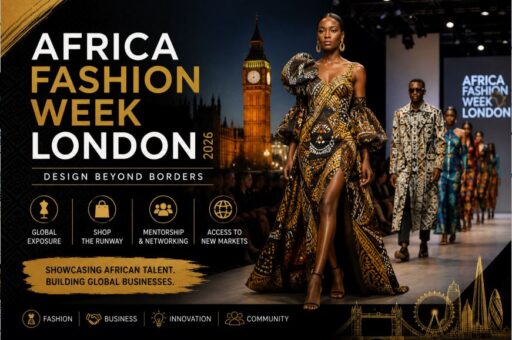
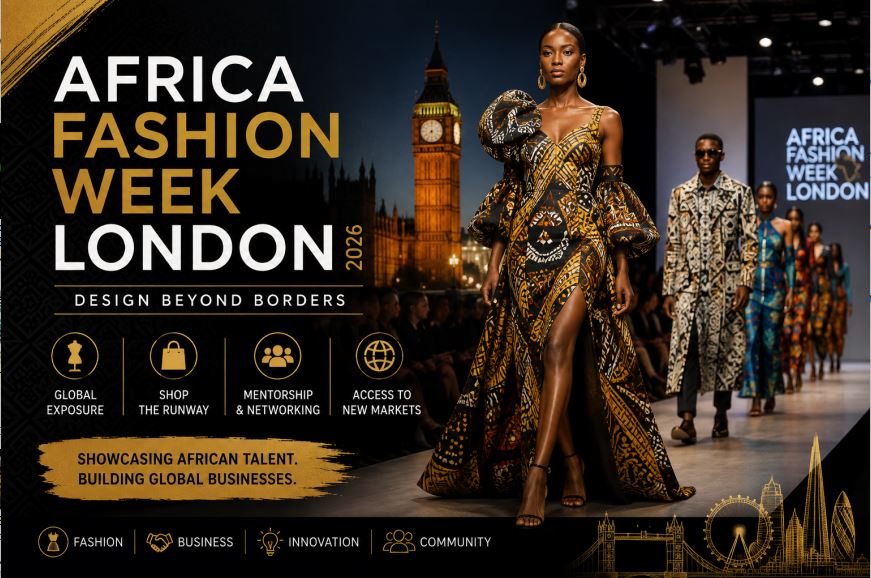
The 16th edition of Africa Fashion Week London ran from August 17 to 23, 2026 in London under the theme “Design Beyond Borders,” bringing African and diaspora designers, brands and creatives into one of Europe’s major fashion capitals. Since launching in 2011, the platform says it has showcased more than 3,000 designers and creatives. But this year’s event was about considerably more than putting African clothes on a runway.
It was about putting African creative businesses in the room.
From runway to retail
One of the most interesting additions to AFWL 2026 was “Shop The Runway.” Rather than ending the relationship between designer and audience when the models leave the catwalk, the initiative allowed visitors, buyers, stylists and media to see collections up close and purchase directly from participating designers. That distinction matters.
Fashion is, after all, a business. A designer can have an incredible collection, receive applause from an audience and generate thousands of social media impressions. None of those things automatically pays the bills. The opportunity to move from “I like this” to “I can buy this” is where creative visibility begins to become commercial value.
AFWL explicitly positioned Shop The Runway as a way of connecting creativity with commerce and creating opportunities for African fashion brands to build sustainable businesses and access global markets. And that may be one of the most important lessons for African creatives across industries.
Visibility is valuable. But access to the market is even more valuable.
The next generation was given a seat at the table
AFWL 2026 also placed significant emphasis on emerging designers. The New Talent Catwalk featured emerging designers and graduate talent, while the Next Gen Runway brought together designers from the British Council’s Creative DNA program, designers from Lesotho and contemporary African brands.
The British Council’s Creative DNA cohort itself included designers from countries including Zimbabwe, Ethiopia, Ghana, Kenya, Nigeria, Rwanda and Uganda, working across areas such as streetwear, accessories, swimwear, tailoring and costume design.
This is important because emerging designers often face a frustrating cycle. They need experience to get opportunities, opportunities to build experience, money to produce collections, customers to generate money and industry connections to find those customers.
Programs such as Creative DNA attempt to break that cycle by combining mentorship, business development and international exposure rather than simply telling young creatives to “work hard and network.”
For an African designer trying to build a brand, being introduced to the right buyer or industry professional can be just as valuable as being featured on a runway.
London becomes more than a location
There is also a reason the location matters. London is not simply another city where a fashion show happened. It is a global fashion and commercial hub with access to international media, buyers, retailers, stylists, investors and consumers.
That means an African designer appearing at AFWL is potentially stepping into a network that extends far beyond the audience physically sitting in the venue. This is particularly important for brands from markets where the domestic fashion ecosystem is still developing.
A Nigerian, Ghanaian, Kenyan or Lesotho designer does not necessarily need to abandon their home market to become global. They need bridges between the local creative ecosystem and international markets.
AFWL is increasingly trying to become one of those bridges. Its program included industry talks, knowledge exchange sessions, an AI-in-design seminar and designer surgeries alongside the runway and exhibition program. That combination is revealing.
The event isn’t treating fashion purely as entertainment. It is treating it as an industry that requires skills, technology, business knowledge, networks and capital.
Lesotho’s presence tells another story
One of the more interesting elements of this year’s program was the presence of designers from Lesotho. Through a partnership involving GIZ Lesotho, the European Union, the German Government and the Government of Lesotho, Basotho designers were given an opportunity to showcase their collections in London and subsequently connect with audiences through the Shop The Runway program.
That matters because African fashion is often discussed as though the continent has one aesthetic but it doesn’t. The fashion coming out of Lagos is not the same as the fashion coming out of Accra, Nairobi, Kigali or Maseru. The opportunity is not to create one generic definition of “African fashion.”
It is to create enough international demand for the different identities, techniques and stories coming from the continent.
African fashion is becoming a cultural export
There is also a bigger economic conversation hiding underneath all of this. African fashion has traditionally been discussed primarily through the lens of culture and identity and those things remain important.
Fashion is also an industry involving manufacturing, textiles, photography, modelling, styling, marketing, logistics, retail, e-commerce, content creation and intellectual property. When an African designer enters an international market, the opportunity does not stop with the person who designed the clothes. It can create opportunities across an entire creative supply chain. That is why platforms such as AFWL matter. They create spaces where different parts of that ecosystem can meet.
The real test starts after the runway
Of course, a successful fashion week does not automatically create successful fashion businesses. The real question is what happens after the lights go down.
Do the designers gain new customers?
Do buyers place orders?
Do brands secure distribution?
Do collaborations emerge?
Do African designers receive repeat business rather than one-off exposure?
Do consumers outside Africa become long-term customers?
Those are the metrics that will ultimately determine whether international showcases are creating sustainable economic value. And that is the challenge facing African fashion more broadly. The continent does not need another conversation about whether its creatives are talented because that question has already been answered.
What it needs are more systems that help talented people build, sell, scale and export. Africa Fashion Week London 2026 program is an interesting example of that shift. The runway may have provided the spectacle, exhibitions provided the visibility, mentorship provided the knowledge and initiatives like Shop The Runway provided the commercial bridge.
For African creatives, that combination may be far more important than the applause because the next phase of African fashion will not simply be about getting the world to notice African designers.
It will be about getting the world to buy from them.
Up Next is the Nigeria Fashion Week. Are you a designer or an exhibitor and you’d love to participate? You can find More details here