Création Africa 2 – 15 South African Creative Businesses Get France-Backed Incubation Program
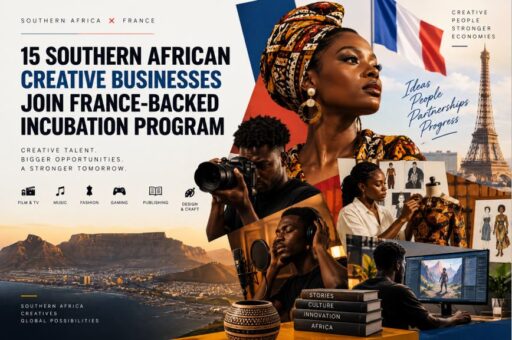
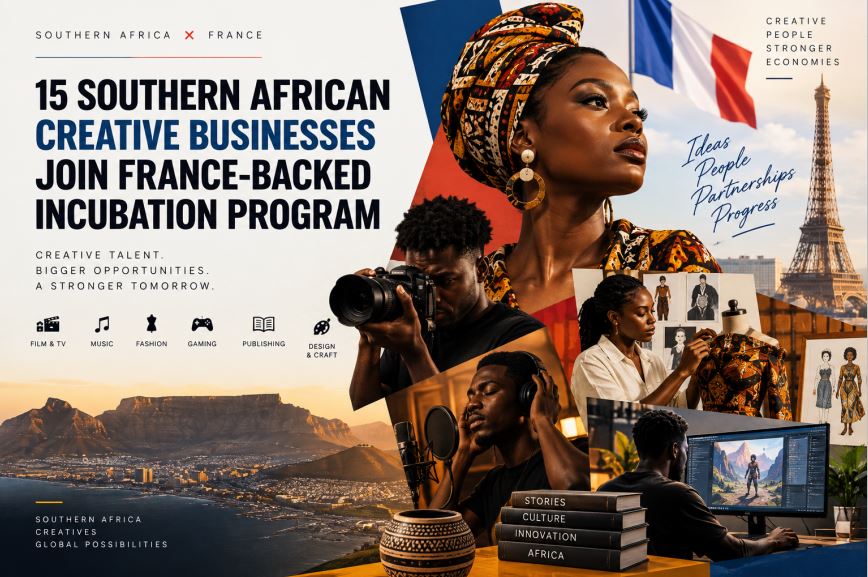
15 Southern African Creative Businesses Just Entered a France-Backed Incubation Program
For years, Africa’s creative economy has had an uncomfortable contradiction. The continent has no shortage of creative talent, but many of the businesses built around that talent struggle to access the things that allow ordinary businesses to grow: capital, strategic support, market access and investment networks. A new program in Southern Africa is attempting to address exactly that gap.
Fifteen creative businesses from South Africa, Lesotho and Malawi have been selected for the final incubation phase of Creation Africa 2, a France-backed program designed to help creative entrepreneurs strengthen their businesses and become investment-ready.
The businesses were selected from more than 340 applications across the three countries. Before reaching the final 15, 50 entrepreneurs went through a seven-week mentorship phase and a final pitching process.
Now, the selected creative businesses are entering a seven-month tailored incubation program running until October 2026 and this isn’t simply another accelerator telling creatives how to improve their Instagram pages. The program is focused on something considerably more important: turning creative ideas into investable businesses.
The 15 businesses are doing far more than making art
The diversity of the cohort is perhaps the most interesting part. The selected businesses span music, digital media, gaming and interactive media, film and television, animation, publishing, design, craft and fashion.
Among them is Music Business Lab, founded by music executive Ninel Musson in Johannesburg, which focuses on building the professional infrastructure around artists through education covering artist management, publishing, rights administration, marketing, data, contracts and entrepreneurship.
There is also iQHAWE Media, a woman-led creative agency and publishing platform working across editorial publishing, digital storytelling, cultural research and exhibitions.
In gaming and interactive media, Vetkoek Studios is building games and interactive content rooted in African experiences for global audiences.
And in film, television and animation, Better Yet is developing a transmedia model that turns existing African cultural assets including films, books, performances and artworks—into additional formats such as immersive experiences, XR, interactive works, merchandise and screen adaptations.
That last example is particularly interesting. It demonstrates that the opportunity in Africa’s creative economy isn’t simply to produce more content. Rather, it is to find more commercial life for the content that already exists.
Fashion is represented too
The fashion contingent includes brands such as SWANK JOZI, Thethana, GUGUBYGUGU, LEO SZN and House of Xandria.
These businesses are tackling different parts of the fashion value chain. SWANK JOZI uses streetwear as a vehicle for storytelling and social commentary and Thethana works with Basotho cultural heritage and traditional textiles to create contemporary, export-ready fashion.
GUGUBYGUGU is focused on South African natural fibres such as mohair and merino wool and positioning them within global luxury markets.
Meanwhile, LEO SZN operates slightly differently: it provides business, branding and market-development support to designers and beauty brands, effectively sitting between creative talent and commercial opportunity.
That range matters as it shows that a creative economy isn’t made up only of the people producing the final product. There is an entire layer of businesses providing the infrastructure around creators.
What the program is actually trying to fix
Création Africa 2 is being delivered through CAPACITI, UVU Africa’s digital skills and enterprise development platform, with support from Team France.
The incubation phase is designed to help the selected entrepreneurs strengthen their business models and value propositions, while giving them access to investor networks, sector expertise, strategic guidance and funding-readiness support.
This distinction is essential because a creative founder can have an excellent product and still not be investment-ready as an investor wants to understand:
How does this business make money?
Who is the customer?
How large is the market?
What makes the business defensible?
What does growth look like?
What happens when more capital enters the company?
How does the founder measure performance?
Creative businesses have historically struggled to answer some of those questions in a language that traditional investors understand. Incubation programs like Création Africa are essentially trying to build that bridge.
Why France is interested
France’s involvement is also part of a wider push to strengthen cultural and creative industries as economic sectors.
Création Africa, a France-Backed Incubation Program is an initiative of the French Ministry for Europe and Foreign Affairs, the French Embassy and the French Institute of South Africa, with the program specifically targeting cultural entrepreneurship in South Africa, Lesotho and Malawi. That makes the program more interesting than a conventional entrepreneurship competition.
It is also an example of international cultural cooperation increasingly moving towards creative enterprise development. The logic is straightforward.
If African creative businesses become stronger, they create jobs, generate intellectual property, develop new products, enter international markets and create opportunities for cross-border collaboration. Culture becomes an economic relationship.
And the numbers tell their own story
The program received more than 340 applications and only 15 businesses made it through. That means the program is effectively selecting a small group of businesses from a much larger pool of entrepreneurs who are already trying to commercialize creativity across the region.
The final cohort is also notably female-led, with women accounting for 67% of the selected businesses, according to reporting on the program.
That is worth paying attention to because conversations about Africa’s creative economy often focus on the output; music, films, fashion, games and art without examining who is actually building the businesses behind that output. Création Africa is doing the latter.
The bigger lesson for African creatives
The most important part of this program may not be the incubation itself. It is the message behind it.
Creative talent alone isn’t enough.
If Africa wants its creative economy to become a serious economic force, creative people need businesses capable of surviving beyond a successful project.
A fashion designer needs a supply chain.
A filmmaker needs financing and distribution.
A musician needs rights management and professional teams.
A game developer needs capital and access to global markets.
A publisher needs distribution.
A creative agency needs systems and recurring clients.
The creative idea is only the beginning.
Africa doesn’t just need more creatives. It needs more creative companies.
This is where program like Création Africa become interesting. The goal isn’t simply to make the selected entrepreneurs better at their craft. It is to help them become better operators of creative businesses and that may be one of the most important shifts happening across Africa’s creative economy.
The continent has spent years proving that it can produce culture that travels. Now the challenge is building companies that can capture more of the economic value created by that culture.
The 15 businesses entering Création Africa 2 are a small cohort but they represent a much bigger question:
Can African creative businesses become investment-ready, scalable companies without losing the cultural identity that made them valuable in the first place?
If the answer is yes, programs like this could become less of an intervention and more of a blueprint for how Africa builds its next generation of creative businesses.