The $5bn Niger Delta Creative-Economy Ambition – FOAN Group
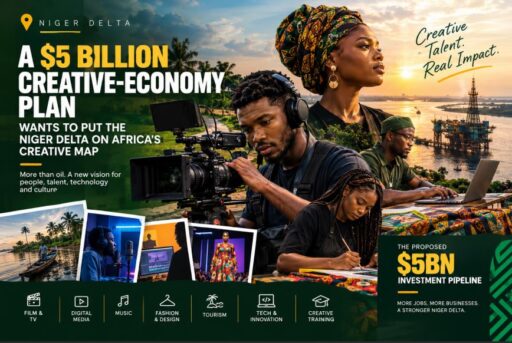
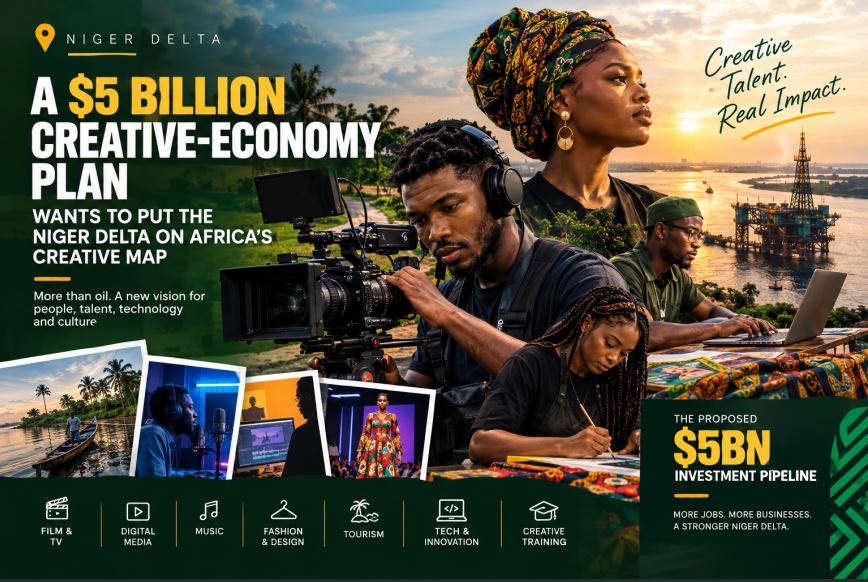
A $5 Billion Creative-Economy Plan Wants to Put the Niger Delta on Africa’s Creative Map
FOAN Group says it wants to build a major media, technology and creative hub in Akwa Ibom. The bigger question is whether the Niger Delta can turn its people, infrastructure and creative talent into an economy beyond oil.
For decades, when the Niger Delta entered Nigeria’s economic conversation, the discussion usually started and ended with oil.
The region supplied a significant part of the country’s petroleum wealth, but its identity became tied so closely to extraction that other forms of economic value often struggled to command the same attention.
Now, a Nigerian media and technology group is proposing a very different story. FOAN Group has announced a long-term investment pipeline valued at up to $5 billion to position Akwa Ibom and the wider Niger Delta as a major creative and digital hub in Africa. There is an important qualification here: the $5 billion is the projected long-term value of a multi-phase investment pipeline, not $5 billion already sitting in a bank account or already deployed.
While that distinction matters, so does the ambition because at the centre of the proposal is an idea that Nigeria’s creative economy has not fully explored:
What if some of Africa’s next major creative businesses are built outside Lagos?
The proposed hub starts in Uyo
The plan is anchored by the proposed C54News Global Streaming Dome at Dakkada Tower in Uyo, which FOAN says will bring together news production, documentary filmmaking, streaming technology, digital enterprise and professional training.
The wider network is designed to connect Uyo with production operations in Nairobi, a commercial hub in South Africa and an editorial hub in Senegal, giving the project a pan-African rather than purely Nigerian structure.
The Uyo facility is expected to support activities including:
Digital journalism
Documentary production
Cinematography
Broadcast engineering
Data journalism
Animation
Graphics
Podcasting
Streaming technology
Virtual production
That list is significant because it moves the conversation beyond “let’s build a studio.” It is closer to building an ecosystem where people can be trained, produce content, work with technology, find commercial opportunities and potentially distribute their work to audiences outside Nigeria.
The infrastructure problem is bigger than a building
In our recent articles, we’ve been able to establish that africa doesn’t necessarily have a shortage of creative people. Rather, it has a shortage of infrastructure that allows creative people to consistently turn their talent into commercially sustainable work. A filmmaker may have the idea but not the equipment. An animator may have the skills but not the hardware. A producer may have a project but no professional studio. A journalist may have a story but no distribution infrastructure and a creator may have an audience but no access to international markets.
That is why a project like the proposed Streaming Dome is potentially more interesting than the physical facility itself. If it works as intended, it could provide a pathway from:
training → production → distribution → audience → revenue.
And that is much closer to how a creative economy actually works.
FOAN says the facility will function as a practical training environment, allowing participants to work with professional production systems while contributing to content intended for African and international audiences.
But Why Akwa Ibom?
The choice of Akwa Ibom is arguably the most interesting part of the announcement. Nigeria’s creative industries are heavily concentrated in a few cities, particularly Lagos. Lagos has the infrastructure; the agencies, production companies, the investors, networks and the audience. But concentration comes with a cost. It means talented people elsewhere often have to relocate to participate fully in the creative economy.
FOAN’s proposal is effectively asking:
What if the opportunity travels to the talent instead?
That could be important for Akwa Ibom and the wider Niger Delta. The project could create opportunities not only for journalists and filmmakers, but also for editors, animators, camera operators, sound engineers, graphic designers, developers, producers, digital marketers, researchers and other specialists who make modern creative businesses function.
FOAN says the project is intended to allow talent from Akwa Ibom and the Niger Delta to access continental and international markets without having to relocate to established creative centres. That is potentially a bigger economic proposition than simply attracting a media company to Uyo.
The $5 billion headline needs to be handled carefully
This is where the announcement deserves some healthy skepticism. A $5 billion investment pipeline is not the same thing as $5 billion in committed capital.
FOAN itself has clarified that the figure represents the projected long-term value of a multi-phase investment pipeline. So this isn’t a story about $5 billion being immediately spent on studios, equipment and jobs. It is a story about a company outlining an extremely ambitious long-term plan and ambitious plans are easy to announce.
The difficult part is execution:
How much capital is actually deployed?
How many jobs are created?
How many businesses are supported?
How many people are trained?
How much revenue is generated locally?
How many productions are made in Akwa Ibom?
How many Nigerian and African intellectual properties are created?
How much of the resulting value remains in the region?
Those will be the numbers worth watching.
Because a creative economy is not built with buildings alone
This is perhaps the biggest lesson for policymakers and investors. You can build a beautiful studio and still not have a creative economy. This is because you need people who can use it, companies that can pay them, financing, reliable electricity and internet, production equipment, distribution, intellectual-property protection, buyers, audiences and businesses capable of turning creative output into recurring revenue.
The facility therefore matters only if it becomes part of that larger ecosystem. Otherwise, it risks becoming another impressive piece of infrastructure without enough commercial activity around it.
The Niger Delta already has something valuable: a reason to diversify
There is also a symbolic dimension to this. For a region historically associated with oil extraction, building an economy around stories, data, technology, filmmaking and intellectual property represents a different way of thinking about natural resources. The resource is no longer only what is beneath the ground. It is the human capital above it.
FOAN’s CEO, Idris-Etanami Usman, described the plan in those terms, arguing that the Niger Delta has been defined primarily by the resources extracted from its soil and that the proposed investment is intended to create value from its people, ideas, culture, technology and creative capacity.
That is a powerful proposition and it is one that other regions across Nigeria could eventually consider.
Could Uyo become another creative hub?
That may sound ambitious today but creative ecosystems often begin with a few institutions and businesses creating enough activity to attract the next layer. One production company brings filmmakers. Those filmmakers need editors. Editors need studios. Studios need equipment suppliers. Productions need hotels, transport, catering and locations. Companies need marketers and accountants. Creators need lawyers. Successful projects create demand for more projects and eventually, a cluster begins to form.
The economic benefit therefore doesn’t necessarily stop with the company that owns the facility.
The real value is in everything that grows around it.
That is the model Akwa Ibom would need to pursue if it wants the project to become a genuine creative-economy engine.
Nigeria needs more creative cities, not just more creative people
This is perhaps the biggest reason the announcement is worth watching. Nigeria already has an enormous supply of creative talent. What it lacks is enough creative infrastructure to absorb that talent and connect it to paying markets.
Lagos cannot and shouldn’t have to carry the entire country’s creative economy. If Uyo can build a meaningful media and digital cluster, it could demonstrate that creative businesses can thrive in other Nigerian cities. That could have implications far beyond Akwa Ibom. Enugu could build around film and television. Abuja could deepen its media, documentary and policy-content ecosystem. Benin could lean further into its cultural and artistic heritage. Kano could build around Hausa-language film, animation and media. Calabar could strengthen its tourism and cultural economy.
The point isn’t to replicate Lagos in every city. It is to build specialized creative economies around the strengths of different places.
The $5 billion question isn’t really about $5 billion
It is tempting to make the headline number the entire story but the more important question is what that money, if eventually deployed, would actually create. A $5 billion pipeline that produces little more than buildings would be a disappointing outcome.
A smaller investment that creates thousands of skilled jobs, supports hundreds of creative businesses, produces exportable intellectual property and establishes a sustainable media and technology cluster could ultimately be far more valuable.
So the real question for FOAN and for Akwa Ibom is not simply:
“Can you invest $5 billion?”
It is:
“Can you build an ecosystem where every dollar invested creates more creative businesses, more intellectual property, more jobs and more revenue?”
If the answer eventually becomes yes, then Niger Delta could begin telling a very different economic story.
Not just a region that produces resources for Nigeria but a region that produces ideas, stories, technology and intellectual property that Nigeria and the rest of Africa can sell to the world.