Gamescom 2026 Cologne, Germany – Nigeria Makes Debut Appearance
Nigeria Took Its Games Industry to Gamescom. Now It Has to Turn Attention Into Business
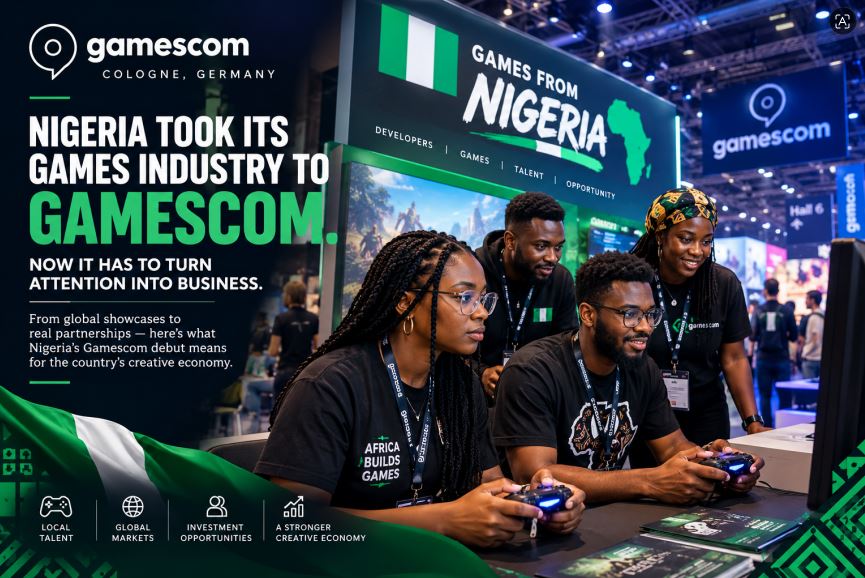
Nigeria’s first national pavilion at Gamescom was more than a showcase. It was an attempt to put Nigerian game developers in front of the publishers, investors and platforms that can turn creative talent into a global business.
For a long time, conversations about Nigeria’s creative economy have been dominated by music, film and, increasingly, fashion.
Gaming has quietly been building in the background.
Now, Nigeria is making a more deliberate attempt to put its game developers in the same international rooms where the global games business is negotiated.
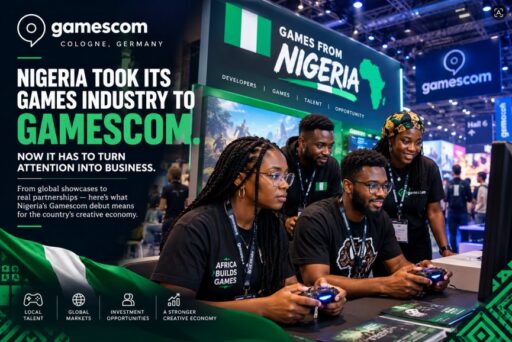
At Gamescom 2026 in Cologne, Germany, Nigeria had its first-ever national pavilion, “Games from Nigeria,” bringing together a 10-person delegation of developers, studios and ecosystem organisations. The pavilion ran from August 26 to 28 and was led by Maliyo Games founder and CEO Hugo Obi, with support from the French Embassy in Nigeria.
That may sound like another international showcase but it wasn’t. The more important question is what Nigeria’s developers were actually doing there and the answer was business.
Getting Nigerian games into the right rooms
Gamescom is one of the world’s major gatherings for the games industry, bringing together developers, publishers, investors, platforms, media and players.
So showing up with a national pavilion changes the proposition.
Instead of an individual Nigerian developer trying to find their way around an enormous international industry event, Nigeria’s games ecosystem had a dedicated space from which to present itself.
The pavilion featured studios and ecosystem players including Maliyo Games, Africacomicade, Dimension11 Games, CodeBox Games and Gazuntype, alongside African industry participants. Its programme included game demonstrations, developer meet-and-greets, presentations on Nigeria’s games ecosystem, discussions around talent and funding, and an Africa Games Industry Mixer designed to connect developers with international publishers, investors and platform leaders.
That last part is particularly important.
Because the biggest challenge for a game developer isn’t necessarily making a game.
It is getting the game into the market.
Africa already has the players
The timing is significant.
Africa’s games market is no longer some distant future opportunity waiting to happen.
New forecasts from Carry1st and Newzoo estimate that Africa’s games market will generate about $1.98 billion in revenue in 2026, up 11.9% from 2025. The continent’s player base is expected to reach more than 406 million people, with mobile accounting for roughly 82% of revenue.
That creates an interesting contradiction.
Africa has hundreds of millions of players.
But the continent still has a relatively small number of globally recognized game studios and intellectual properties.
Nigeria sits in a particularly interesting position.
The Africa Games Industry Report identifies Nigeria as one of the continent’s key gaming markets, while previous industry research has pointed to rapid growth in the country’s mobile gaming market.
The opportunity, therefore, isn’t simply to get Nigerians playing more games.
It is to get more Nigerian-made games into the hands of those players and players everywhere else.
This is where the money gets interesting
A successful game can become much more than a one-time digital product. It can become intellectual property.
A character can become a franchise. A game can generate revenue through sales, in-app purchases, advertising, licensing, merchandising and partnerships and a successful property can potentially expand into animation, film, publishing, toys or other forms of entertainment.
We’ve already seen how Nigerian creative properties can travel across formats. The question is whether gaming can produce the next generation of Nigerian-owned IP.
Imagine a Nigerian game character becoming as recognizable as a character from a global animation franchise. That is where the economic opportunity starts becoming much bigger than game development.
But getting there will require more than talent
Nigeria’s developers have already demonstrated that they can make games.
The harder part is building an ecosystem that allows them to do it consistently and commercially.
The African games industry still faces problems around funding, infrastructure, access to international markets and monetization. The 2026 African Video Game Report points to unreliable electricity, limited internet access, fragmented payment systems and the need for stronger business training as some of the structural constraints holding studios back.
That matters because making a game can take years.
A studio needs people who can code, design, animate, write, produce, market and manage a business.
Then it needs money to keep those people employed long enough to finish the product.
Then it needs distribution.
Then marketing.
Then customer support.
Then another project to keep the studio alive after the first game.
The creative part is only one part of the business.
Gamescom is useful because it tackles the access problem
This is why Nigeria’s presence at Gamescom matters beyond the pictures from Cologne.
A developer can spend years building a game in Lagos, Abuja or another Nigerian city without ever meeting the publisher who could distribute it globally.
They can build an impressive prototype without knowing an investor who understands the games business.
They can have a good game without having the relationships required to get it onto the right platforms.
International industry events compress those distances.
And Nigeria’s pavilion was designed precisely around those connections.
Maliyo Games described its participation as an opportunity to connect with studios, publishers, investors, creators, press and platforms around African games and mobile-first play.
That is the commercial value of showing up.
Visibility is useful. Access is better.
The real test starts after Cologne
There is, however, a danger in celebrating international showcases too much.
A pavilion can create attention.
It cannot automatically create a sustainable industry.
The real question is what happens after the event.
Did Nigerian studios secure publishing deals?
Did investors commit capital?
Did platforms sign distribution agreements?
Did developers find international partners?
Did new games get funded?
Did Nigerian IP find audiences outside the country?
Did the delegation lead to jobs?
Those are the outcomes that will tell us whether Gamescom was simply a good publicity moment or the beginning of something commercially significant.
And that is where Nigeria should be ambitious.
The goal shouldn’t be to become the African country that attends Gamescom.
It should be to become the African country whose studios need to be at Gamescom because the global industry wants what they are building.
Nigeria has a story to sell
One advantage Nigerian game developers have is the same advantage that has helped the country’s music and film industries travel: there is a lot of culture to draw from.
Nigerian mythology, folklore, cities, languages, humour, history and contemporary life all provide material for original worlds and characters.
But culture alone doesn’t make a successful game.
The industry needs commercial thinking around that culture.
Which stories can travel?
Which audiences will pay?
Which characters can become franchises?
Which games can be localised?
Which intellectual property can expand into other formats?
And, perhaps most importantly:
Who owns the IP?
If Nigerian developers can answer those questions, gaming could become another route through which Nigerian creativity is exported to the world.
The bigger opportunity is ownership
This may ultimately be the most important part of Nigeria’s Gamescom debut.
Nigeria has spent years proving that its creatives can attract global audiences.
Music did it.
Film did it.
Fashion is increasingly doing it.
Gaming offers another opportunity but with a slightly different economic proposition.
A song can become a hit.
A film can become a global title.
But a game can become a world.
And worlds can contain characters, stories, communities, merchandise, sequels, adaptations and entire franchises.
That means the opportunity isn’t simply for Nigerian developers to make games for Nigerian players.
It is for Nigerian developers to own pieces of the global interactive entertainment economy.
Gamescom has given them a bigger room to introduce themselves.
Now comes the harder part:
turning Nigerian talent into Nigerian-owned IP, and turning international attention into international revenue.