FG iDICE Skills to Jobs Program 2026: Training For 300,000 Nigerians
FG iDICE Skills to Jobs Program 2026: How 300,000 Nigerians Can Gain Digital Skills and Find Work
For years, Nigeria has faced a frustrating contradiction.
Millions of young Nigerians are entering the workforce every year, yet employers continue to complain about a shortage of people with the practical skills they need.
At the same time, many young people are learning skills independently but struggle to find a clear path from learning a skill to actually earning from it.
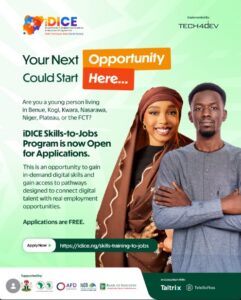
That gap is exactly what the Federal Government’s Investment in Digital and Creative Enterprises (iDICE) programme is attempting to address with its Skills-to-Jobs initiative.
And for young Nigerians interested in technology, freelancing, business process outsourcing and the creative economy, this could be one of the more significant government-backed opportunities to watch in 2026.
What Is the iDICE Skills-to-Jobs Programme?
iDICE stands for Investment in Digital and Creative Enterprises.
It is a Federal Government initiative implemented by the Bank of Industry (BOI) and supported by development-finance partners including the African Development Bank, Agence Française de Développement and the Islamic Development Bank.
The wider programme is designed to strengthen Nigeria’s technology and creative sectors through skills development, enterprise support, infrastructure and access to finance.
Its Skills-to-Jobs component takes a particularly practical approach.
Rather than simply training people and handing them certificates, the objective is to build a pathway that looks more like:
Skills → Training → Industry Readiness → Jobs → Income
That distinction matters.
Because a certificate without an economic opportunity doesn’t necessarily change someone’s life.
The Programme Is Designed to Reach Young Nigerians Nationwide
According to current iDICE programme information, the wider initiative is targeting young Nigerians between 15 and 35 years old for technology and creative skills development.
The programme’s nationwide ambition is significant.
BOI materials describe iDICE as a nationwide digital skills and enterprise programme targeting more than 300,000 Nigerians, with more than 41,000 beneficiaries already prospected in 2025.
The programme is also expected to develop innovation infrastructure across the country, including hubs and centres connected to universities and polytechnics.
That matters because Nigeria’s technology and creative opportunities have historically been concentrated around major cities such as Lagos and Abuja.
A truly nationwide programme has the potential to give young people outside those traditional hubs access to training and networks they might otherwise struggle to find.
But This Isn’t Just About Learning How to Code
One of the most interesting things about iDICE is the breadth of the sectors it covers.
The programme is focused on both digital and creative enterprises.
That means the opportunity extends beyond software development.
Nigeria’s creative economy needs people working across:
Design
Animation
Film
Music
Gaming
Digital content
Digital marketing
Technology
Business services
Entrepreneurship
The programme’s official platform specifically highlights creative-industry interventions covering areas such as film, animation, music, gaming and design, alongside technology and business support.
For creatives, this is an important shift in how skills development is being approached.
Your creativity isn’t necessarily just a hobby.
It can be a marketable skill.
The BPO Opportunity Is Particularly Interesting
One of the programme’s major Skills-to-Jobs components is Business Process Outsourcing (BPO).
BPO essentially involves businesses outsourcing certain functions—such as customer support, administrative services, data-related tasks and other business processes—to specialised workers or companies.
For Nigeria, this presents an opportunity to sell skilled services to both local and international businesses.
The iDICE programme has already been procuring training providers for BPO Skills-to-Jobs programmes across Nigeria’s geopolitical zones.
A North-West programme document, for example, specifically states that training-to-jobs is a major pillar of iDICE and requires trainers capable of providing BPO training and linking trainees with employment opportunities after training.
That’s a crucial part of the model.
The objective isn’t simply:
“Learn customer service.”
It is closer to:
“Learn customer service, become work-ready, and have a pathway toward employment.”
50,000 Young People Per Zone?
Current programme information circulating around the 2026 Skills-to-Jobs rollout indicates a target of 50,000 young people in each of Nigeria’s six geopolitical zones, potentially reaching 300,000 people nationwide.
That would mean the programme isn’t being designed as a small Lagos-centric training scheme.
It is intended to cover all six geopolitical zones, across the 36 states and the Federal Capital Territory.
That scale is important because Nigeria’s skills gap isn’t concentrated in one city.
There are talented young people in Enugu, Kano, Kaduna, Ibadan, Benue, Rivers, Cross River and countless other locations who may simply lack access to the same opportunities available in Lagos.
A nationwide approach could change that.
Why This Matters for Nigerian Creatives
For creatives, the bigger lesson isn’t just “apply for a training programme.”
It’s that the Nigerian economy is increasingly recognising creative and digital skills as economic assets.
That is a significant shift.
For years, young people were often encouraged to pursue traditional professional paths while creative careers were treated as secondary options.
But industries such as music, film, gaming, animation, design and digital content are creating their own businesses, jobs and international markets.
iDICE is effectively acknowledging that reality by putting digital and creative skills within a major national economic-development programme.
Training Alone Won’t Solve the Problem
There is, however, an important question Nigeria must answer.
What happens after the training?
This is where the Skills-to-Jobs model becomes particularly important.
Nigeria has had numerous skills-acquisition programmes over the years.
The challenge has often been whether participants can convert those skills into sustainable income.
A young person may complete a six-week digital marketing course.
But can they get their first client?
Can they work remotely for an international company?
Can they build a business?
Can they earn enough to make the skill economically meaningful?
That’s why job placement, industry partnerships, apprenticeships, freelancing opportunities and entrepreneurship support are just as important as the training itself.
The official iDICE framework recognises this connection between skills, employability and enterprise creation.
And iDICE Goes Beyond Training
This is perhaps the part many people may overlook.
iDICE isn’t simply a government training programme.
The wider initiative has a reported funding envelope of approximately $617.7 million, backed by the Federal Government, AfDB, AFD and IsDB, with BOI serving as the implementing agency.
The programme combines:
Skills development
Startup support
Innovation infrastructure
Enterprise development
Access to finance
Creative-industry programmes
Policy and ecosystem development
That creates a much larger pipeline.
Someone can potentially enter through skills development and eventually progress toward entrepreneurship and enterprise support.
That is the kind of ecosystem Nigeria needs if it wants its digital and creative sectors to become major contributors to the economy.
What Young Nigerians Should Take From This
If you’re a young Nigerian looking to build a career in the digital or creative economy, programmes like this should change how you think about learning.
Don’t collect certificates simply because they are free.
Ask:
What skill am I learning?
Who needs this skill?
How much are they willing to pay?
Can I work for companies outside Nigeria?
Can I freelance with it?
Can I build a business around it?
What portfolio can I create while learning?
This is particularly important for creatives.
Don’t finish a design course and wait for someone to call you a designer.
Build projects.
Create a portfolio.
Work with other creatives.
Take small jobs.
Document your results.
Learn how to sell.
Understand contracts and intellectual property.
Build your personal brand.
The skill is only the beginning.
Nigeria’s Real Opportunity Is Turning Skills Into Income
The most exciting part of the FG iDICE Skills-to-Jobs program 2026 isn’t the number of people it plans to train.
It’s the possibility of creating a stronger connection between what Nigerians learn and what the economy actually needs.
Nigeria doesn’t simply need more trained young people.
It needs more young people who can produce value, find work, build businesses and earn from their skills.
That’s a much bigger goal.
And it is particularly important for the creative economy, where talented people often have the skills to create but lack the business knowledge, networks and opportunities required to turn those skills into sustainable careers.
Final Thoughts
Nigeria’s digital and creative economy has already shown that its talent can compete globally.
The next challenge is scale.
How do we train more people?
How do we connect them to employers?
How do we help them become entrepreneurs?
How do we help creatives turn intellectual property into businesses?
And how do we ensure that opportunity isn’t concentrated in only Lagos, Abuja and a handful of other cities?
The iDICE Skills-to-Jobs initiative is an attempt to answer some of those questions.
Whether it ultimately achieves its ambitious targets will depend heavily on execution, industry participation and what happens after training.
But the direction is encouraging.
Because skills without opportunity are frustrating, and opportunity without skills is difficult to capture.
The real economic transformation happens when you connect both.
For thousands of young Nigerians in 2026, that connection could be the difference between having a skill and actually building a career from it.
And for the country’s growing creative economy, that could be even more significant.