
Black Star International Film Festival 2026: Africa’s Next Film Wave Is Bigger Than Nollywood
African cinema has never been short of stories. The bigger challenge has always been creating the platforms, audiences, funding and infrastructure capable of helping those stories travel.
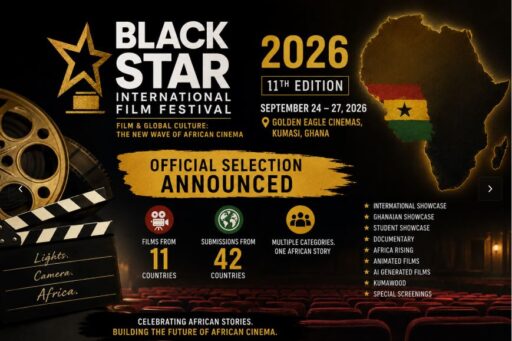
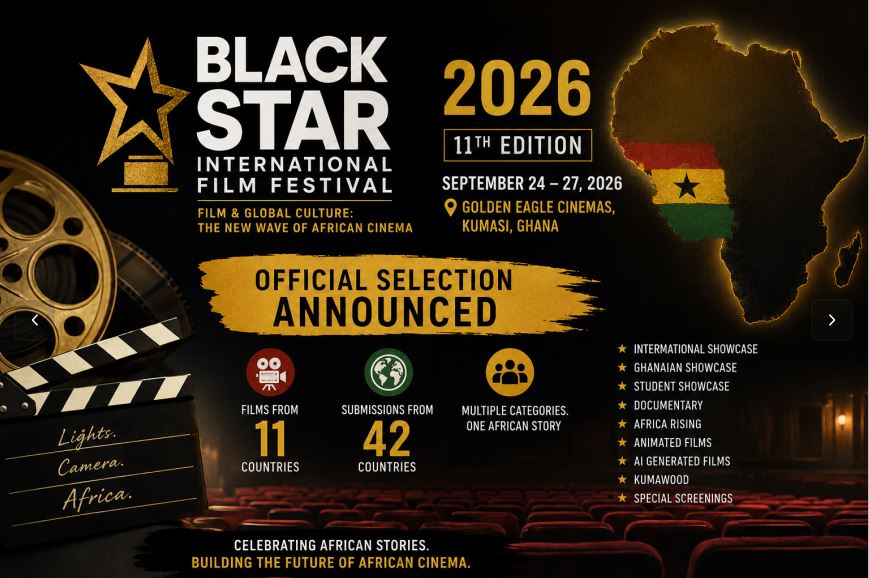
The 2026 edition of the Black Star International Film Festival (BSIFF) in Ghana is offering an interesting response to that challenge. The festival has announced the official selection for its 11th edition, bringing together films and filmmakers from 11 countries for the festival, which will take place from September 24 to 27 at Golden Eagle Cinemas in Kumasi. The final selection was made from submissions representing 42 countries, showing just how far the Ghana-founded festival has grown beyond its home market.
The countries represented in the final selection include Ghana, Nigeria, Uganda, the United States, South Africa, Zimbabwe, China, Cameroon, Singapore, the Dominican Republic and Russia. But the numbers are not the most interesting part of BSIFF 2026. It is the range of creative disciplines represented in the program.
African cinema is becoming more than film
BSIFF’s 2026 program cuts across an International Showcase, Ghanaian Showcase, Student Showcase, Documentary, Africa Rising, Animated Films, AI Generated Films and Kumawood, alongside special screenings. That is important because it reflects how the definition of filmmaking itself is changing.
A filmmaker today could be working with animation, artificial intelligence, documentary storytelling, local-language cinema or traditional film production. These aren’t necessarily separate creative worlds anymore. They are increasingly part of the same ecosystem. BSIFF appears to understand that shift.
Earlier this month, the festival outlined four pillars for its 2026 edition under the theme “Film & Global Culture: The New Wave of African Cinema.” Those pillars focus on local-language cinema, building African audiences, mental health for creatives and emerging technologies such as artificial intelligence. That is a much bigger conversation than simply asking which movie wins an award.
The real opportunity may be the audience
For African filmmakers, getting a movie made is only half the battle. A film still needs an audience and that is one of the issues BSIFF has placed directly on its agenda by making building African audiences one of its four central pillars.
This matters because African creators have historically had to think about international audiences almost immediately. A Nigerian filmmaker might look towards Netflix. A Ghanaian filmmaker might think about diaspora audiences. A Kenyan filmmaker might pursue international festivals.
Global distribution is valuable, but there is also an enormous opportunity in building audiences within Africa itself. A stronger African audience base creates more opportunities for cinemas, streaming platforms, distributors, festivals, advertisers, producers and, ultimately, filmmakers.
The student and emerging-creator angle matters too
One of the most interesting categories in this year’s program is the Student Showcase. For emerging filmmakers, festivals can provide something that is difficult to manufacture online: industry visibility.
A student film selected by a festival can become a filmmaker’s first professional credential. It can create networking opportunities, attract collaborators and introduce the creator to producers or distributors. That means festivals aren’t merely places where finished films are screened.
They can function as part of the career infrastructure of the creative economy and that infrastructure becomes increasingly important as more young Africans enter film, animation, digital storytelling and related creative fields.
Then there is AI
The inclusion of an AI Generated Films category may be one of the clearest signs of where African cinema is heading.
AI is already changing how creators approach ideation, visual development, editing, animation and production. But its inclusion in a major African film festival also raises a more interesting question:
What happens when African filmmakers begin using new technology to tell distinctly African stories?
The conversation around AI in creative industries often gets reduced to whether technology will replace creatives. A more useful question is whether African creators can use these technologies to reduce production barriers and tell stories that may previously have been too expensive or technically difficult to produce.
If that happens, AI may become less about replacing African creativity and more about expanding what African creators can afford to create.
A bigger creative economy is being built around the screen
The significance of BSIFF 2026 is therefore not simply that films from 11 countries will be screened in Kumasi.
It is that the festival is creating a meeting point for filmmakers, students, animation, documentary, technology and emerging forms of storytelling. That is what a healthy creative ecosystem needs.
Creators need platforms to showcase their work. Audiences need opportunities to discover it. Producers need talent. Investors need projects. Distributors need content. And emerging creatives need places where they can enter the industry.
Film festivals can sit in the middle of all of that. Africa’s next film wave, therefore, may not be defined only by how many African films reach international streaming platforms. It may also be defined by how effectively the continent builds the infrastructure to discover, finance, distribute and monetize its own stories.
And that is perhaps the more important story coming out of Black Star International Film Festival 2026. The films may be the attraction but the ecosystem around them could be the real opportunity.