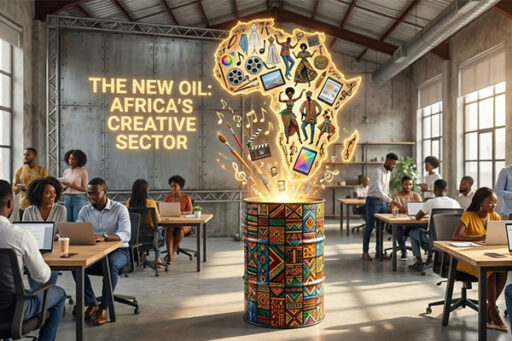
The New Oil: Africa’s Creative Economy Targets $200 Billion Valuation as Industrialization Accelerates
ABUJA, January 14, 2026 — The narrative of Africa’s creative economy has officially shifted from “untapped potential” to “global assertion.” As of January 2026, the continent’s creative sector spanning music, film, fashion, gaming, digital content and advertising is being re-engineered as a primary engine for industrialization and a multi-billion dollar asset class.
The $200 Billion Ambition
Current projections indicate that Africa’s creative industry, currently valued at roughly $60 billion, is on a trajectory to reach $200 billion by 2030. What fuels this growth is a demographic explosion of young digital natives and a global appetite for African cultural exports.
Music streaming remains a standout performer. Following a five-year surge, projections have it that revenues will reach $314.6 million by the end of 2026, more than tripling the $92.9 million record of 2021. This surge is no longer limited to Afrobeats; it now encompasses a diversified portfolio of sounds and digital products being consumed globally.
New Financial Models and Infrastructure
In a landmark shift, African governments and private investors are beginning to treat creative ventures with the same rigor as traditional sectors like oil and gas.
Bilateral Investment:A strategic partnership with France has unlocked €100 million in new funding specifically for Nigerian creative infrastructure.
The AfroLiganza Movement:Nigeria recently became the first signatory to the African Fashion Industry Growth Charter. This initiative aims to unify the continent’s fragmented fashion markets into a cohesive $500 billion ecosystem.
Targeted Financing: The introduction of new financial instruments are to help creators scale beyond individual success. On platforms like Selar, content creator earnings doubled over the last two years. With top-tier full-time creators now seeing an average annual revenue potential of $100,000.
Policy and Trade: Breaking Down Borders
The African Continental Free Trade Area (AfCFTA) is playing a pivotal role in this transformation. The newly unveiled Tourism and Creative Industries Forum is working to harmonize Intellectual Property (IP) protections across borders. By standardizing IP enforcement, the forum aims to ensure that African creators retain the value of their work as it travels across the continent and the globe.
In the academic sphere, the African Journal of Creative Economy (AJCE) has introduced new transparency standards for 2026. This includes compulsory AI disclosure policies to protect the integrity of creative research and production in the age of generative technology.
The Road Ahead: Overcoming Bottlenecks
Despite the optimism, significant hurdles remain. Distribution infrastructure is the most pressing gap. For a population of 1.4 billion people, there are currently only 1,700 cinemas across the continent. Additionally, international payment restrictions continue to stifle the ability of independent creators to monetize their work globally.
Industry experts argue that the next phase of growth depends on “catalytic funding” investments that do more than fund a single project. Rather, build the studios, distribution hubs, and legal frameworks required to turn cultural influence into a sustainable industrial powerhouse.
As 2026 unfolds, Africa is no longer just “the next big thing” in the creative world; it is the current frontier of global cultural and economic innovation.